The Neural Architecture of Slumber: Why Your Brain Craves Silence

Sleep hygiene is not merely a list of evening chores but a biological necessity for pruning neural pathways. By curating the acoustic environment and managing circadian rhythms, we can effectively hack the brain’s transition into deep, restorative slow-wave sleep, fundamentally altering how we process memory and emotional regulation each night.
The Oscillations of the Resting Mind
When we close our eyes, the brain does not simply turn off. Instead, it shifts gears, moving from the chaotic beta waves of daytime problem-solving into the rhythmic, slow-wave delta oscillations of deep sleep. This transition is fragile. It relies heavily on the environment remaining predictable. If you have ever felt startled by a sudden shift in ambient noise, you have felt the brain’s thalamus—the gatekeeper of sensory input—struggle to filter out the external world. When we talk about sleep hygiene, we are really talking about sensory management. Your brain is trying to consolidate the day's experiences, moving them from the short-term storage of the hippocampus to the long-term archives of the cortex. Any auditory disturbance forces the brain to re-evaluate the environment for threats, kicking the amygdala into a state of hyper-vigilance that ruins the quality of your rest.
Acoustic Engineering for the Nervous System
Music is perhaps the most potent tool for manipulating this neural state. Unlike the unpredictable clatter of city streets or the hum of a refrigerator, structured soundscapes can act as a pacing mechanism for the brain. Research into binaural beats and entrainment suggests that by introducing a consistent, repetitive low-frequency hum, we can encourage the brain to sync its electrical activity with that frequency. This is why ambient textures—think of the long, sustained chords in dark ambient or the soft, filtered white noise of a rain machine—are so effective. They provide a predictable baseline that signals safety to the primitive brain. By smoothing out the sharp transients of environmental noise, these soundscapes keep the nervous system in a parasympathetic state, allowing the body to prioritize cellular repair over environmental monitoring.
The Dopamine Trap of the Bedtime Scroll
We often overlook the role of light and stimulation in our sleep rituals. The modern habit of checking screens before bed is a direct attack on our neurochemistry. Blue light exposure suppresses melatonin, but the psychological cost is arguably higher. When you scroll through a feed, you are flooding your brain with dopamine. This neurotransmitter is associated with reward-seeking and anticipation, both of which are antithetical to the state of surrender required for sleep. By forcing the brain to remain in a state of high-arousal information processing, you create a physiological conflict. You are telling your brain that it is time to hunt for information while simultaneously trying to shut down the prefrontal cortex for the night. This friction is why insomnia is so prevalent in our hyper-connected society. We have traded our natural biological rhythms for the flickering, artificial stimulation of the digital void.
Restoration as a Cognitive Discipline
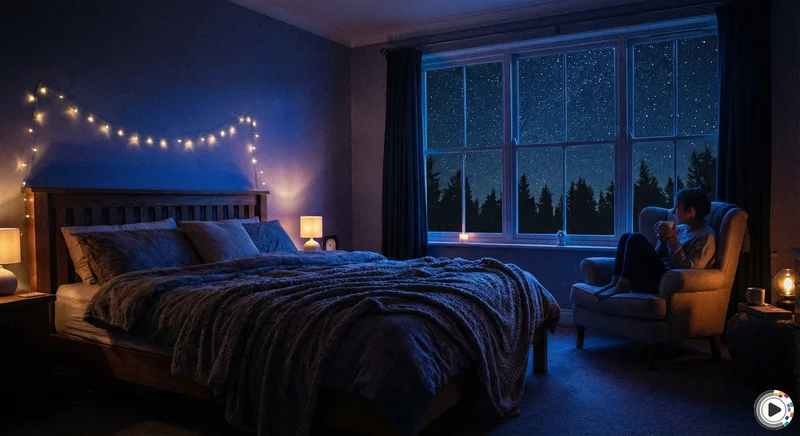
True sleep hygiene requires treating your bedroom as a sanctuary for your biology. This means controlling the temperature to support the natural dip in core body heat that triggers the sleep onset, but it also means respecting the silence. If silence feels oppressive, replace it with textures that do not demand attention. Avoid anything with lyrics or complex harmonic structures; the language centers of the brain will inevitably try to decode the meaning of the words, keeping your mind engaged when it should be disengaging. Instead, opt for drone-heavy compositions that possess a slow, decaying frequency response. These sounds do not ask for your focus. They simply occupy the space, providing a soft acoustic buffer that prevents the brain from snapping back into an alert state at the first sign of a creaking floorboard. Ultimately, you are the architect of your own rest, and the tools you choose to surround yourself with dictate the depth of the recovery your brain achieves before the sun rises again demands your full attention.